About Me

My photo
Hi, welcome to my blog. I'm a writer of poetry, prose and plays but my best known work is children's fiction. My most popular books are the Selby series and the Emily Eyefinger series. This blog is intended as an entertaining collection of thoughts and pictures from here in Australia and from my travels in other parts of the world. I hope you enjoy it. (For more information have a look at my website.)

Monday, April 2, 2012

Kangaroo Carpet

The plan was simple: to visit a national park that we'd never seen before, to shake some city dust from our heels exchanging it for country dust, and to have a look at a particular Aboriginal rock art site. What we hadn't counted on was the amount of Australian wildlife we'd come across.

At the Visitors' Centre at Namadgi National Park south of Canberra the very helpful staff recommended The Yankee Hat Walk as an introduction to the park. I wondered if my Yankee accent had anything to do with this choice. In any event the promise of seeing the rock art and so many Eastern Grey Kangaroos that the fields would look like "a moving carpet of grey" sold us. We were told that the area had "the highest concentration of Eastern Grey Kangaroos (Macropus giganteus) anywhere in Australia". 

Eastern Greys are anything but rare here in Eastern Australia but we never tire of seeing them. Like deer in the Northern Hemisphere, they're always fun watch as long as they stay out of the headlights at dusk. And, speaking of deer, a male kangaroo is a "buck" and a female is a "doe". The young break the pattern by being "joeys" instead of "fauns".

We drove south to the beginning of the walk and found only one car in the carpark at the beginning of the track. A good sign. It was a family of three with bicycles---not a bad way to do this track because it's mostly flat, across fields that had once been a sheep station. The distance to the rock art site is only three kilometres, an easy two and a half hours on foot, there and back.

Not quite a kangaroo carpet but a sizeable mob.
Minutes went by and no kangaroos. Then there was one. And then another. Suddenly we passed a mob (no, the collective noun isn't a "court") of thirty-eight kangaroos. Within the first half hour we saw between one and two hundred. The next time we have friends visiting from overseas and they're not content to see kangaroos at Taronga Zoo, we'll bring them here. We had just happened upon kangaroo heaven.

This young male lost interest in me as I fiddled with my camera settlings.

These were more attentive.

This big male was more interested in his friends and family.

Jill is studiously ignored the encroaching grey carpet.
An echidna waddled across our path. It curled up like a hedgehog when I tried to take its picture but patience paid off and soon its eyes and ant-eating snout reappeared. (Click) Echidna's, along with platypuses, are egg-laying mammals.

Echidna
Another iconic bit of Australian fauna happened by but this one, a big goanna, was not for touching. They're not venomous and not aggressive but they can bite and, when they do, they hang on---forever.

Goanna.
The major species of kangaroo, including the Eastern Grey, are anything but endangered. Their principal predator was the Tasmanian Tiger (aka Tasmanian Wolf) which died out on the mainland about 2,000 years ago and in Tasmania sometime last century. Since then the main predator has been the dingo, the wild dogs introduced by Aboriginal Australians three to four thousand years ago. We didn't see any dingoes but we did see the remains of one of their meals.

When dingo meets kangaroo.
We also didn't see any wombats because they're mostly nocturnal. What we did see was wombat holes and plenty of what we think was wombat scat on top of rocks and logs. Wombats aren't ones to hide their lamps under bushels or their excreta in out of the way places. These animals are truly proud of their poo. Or maybe it wasn't wombat poo that we were seeing. Wombat poo usually comes out square. (Don't ask how.) If you recognise the poo in the picture below, please leave a comment. (We promise it's not ours.)
Essence of wombat?
Finally we came to Yankee Hat Rock Shelter, which we had all to ourselves. The "shelter" is a concave rock face with just enough overhang to protect its paintings from the weather.

Yankee Hat Rock Shelter
The art itself only occupies a small area of about two square metres. The photo below shows about two thirds of the artwork on the rock face so there's not a lot there.

These are the rock paintings.
Below I've attempted to label the figures according to what the National Park people think they represent. Nobody really knows. The images undoubtedly had ceremonial significance but their true meaning may only have been known to the initiated and, even then, their interpretation may have varied with the level of those initiated.


This sort of artwork is rare in this area. There is evidence that there were Aboriginal people in the Canberra region from about 21,000 years ago and there is further evidence that there were people camping near these paintings a long ago as 3,700 years but when these were painted is unknown. They may have been painted and re-painted over many years. The white pigment is clay and the red is ochre, perhaps coming from trade with other Aboriginal people nearer to the coast.

There's a fascination with this sort of artwork that's hard to explain. We can't look at them the way we might with a Western modernist painting such as the works of Pablo Picasso*, Joan Miró or Jean-Michel Basquiat. In other words, they can't have been acts of individual self-expression because there are cultural similarities with other Aboriginal art in Eastern Australia. And their painting is not nearly as polished as much earlier Neolithic cave art from Europe, for example, the bison and deer of the Altamira Cave in Spain. Maybe it's the mystery that moves us: who were these people and why did they paint these images? In any case, we were much moved by what we saw and, after a picnic lunch at the shelter, we picked our way back through the kangaroo carpet and drove to Canberra.

* While putting in the link to Picasso I learned that he was born Pablo Diego José Francisco de Paula Juan Nepomuceno María de los Remedios Cipriano de la Santísima Trinidad Ruiz y Picasso. I just thought I'd mention that.

***************************************************************

Still on the subject of bushwalking: a couple of weeks ago I did The Grand Canyon Walk walk in the Blue Mountains with my walking mate, Richard Tulloch. It's one of my favourite walks in the Blue Mountains. As usual he beat me to a blog about our walk. All the better because his photos are invariably better than mine. Because I've had some feedback from his blog I'd like to state---partly for legal reasons---that I strenuously deny being the "Shifty" in Richard's (highly amusing) write-up.

Friday, March 16, 2012

Lord Timothy Dexter

I finished writing the latest book in the Emily Eyefinger series, Emily Eyefinger and the Secret from the Sea, a couple of months ago. It is now being edited by an excellent editor at HarperCollins, Australia. (Many thanks, Anne.) My first drafts can be messy but after a lot of re-writing I send off what I think is a "clean" manuscript. It's always deflating to get it back with scribbles all over it and pages of notes showing me where I've gone wrong.

At times like these I think of Lord Timothy Dexter. (I wrote about him ages ago but you won't remember.) It's always heartening to be able to point to someone who is worse at something than you are or, in this case, than I am. Lord Timothy is my anti-role model. Or is he my role anti-model? Either way, he was a complete idiot.

In 1798 he wrote and self-published a book with no punctuation at all and CapiTal lettErs UseD At raNdom. Well maybe not quite that random. He couldn't punctuate, he couldn't spell, his grammar was atrocious and he didn't have an editor to hide the fact. Or would that be facts?

His book was called A Pickle for the Knowing Ones or Plain Truth in a Homespun Dress. It was a collection of his thoughts about everything. In it he declared himself, '...the first in the East, the first in the West, and the greatest philosopher in the Western World'. He was no shrinking violet.


For those who complained about the lack of punctuation,  in the second edition of the book, he included a page at the back with nothing but punctuation: rows of commas, exclamation marks, questions marks etc. He told his readers to 'peper and solt it as the plese'. 


Lord Timothy wasn't a lord at all. He was American for starters and America doesn't have a House of Lords. He just called himself "Lord". He was a businessman with a lot of luck. He bought a huge amount of Continental Dollars after the American Revolution when they were worthless only to have the new Secretary of the Treasury reinstate them as the real currency. Suddenly this worthless paper was real money and he was very rich. He used it to do lots of strange things including having statues of famous people made for his front garden. Of course he included a sculpture of himself.

I have to declare an interest here: "Lord" Timothy was my father's mother's father's mother's father's mother's wife. Sadly I can't claim any of his DNA so can't use this as an excuse for the mistakes in my writing. My ancestor was Timothy's second wife and I'm descended not from him but from her marriage to her first husband, if that makes sense. One thing I will say for this highly eccentric man is that his book is in print after 214 years. There aren't many writers who could make that claim so he must have done something right.


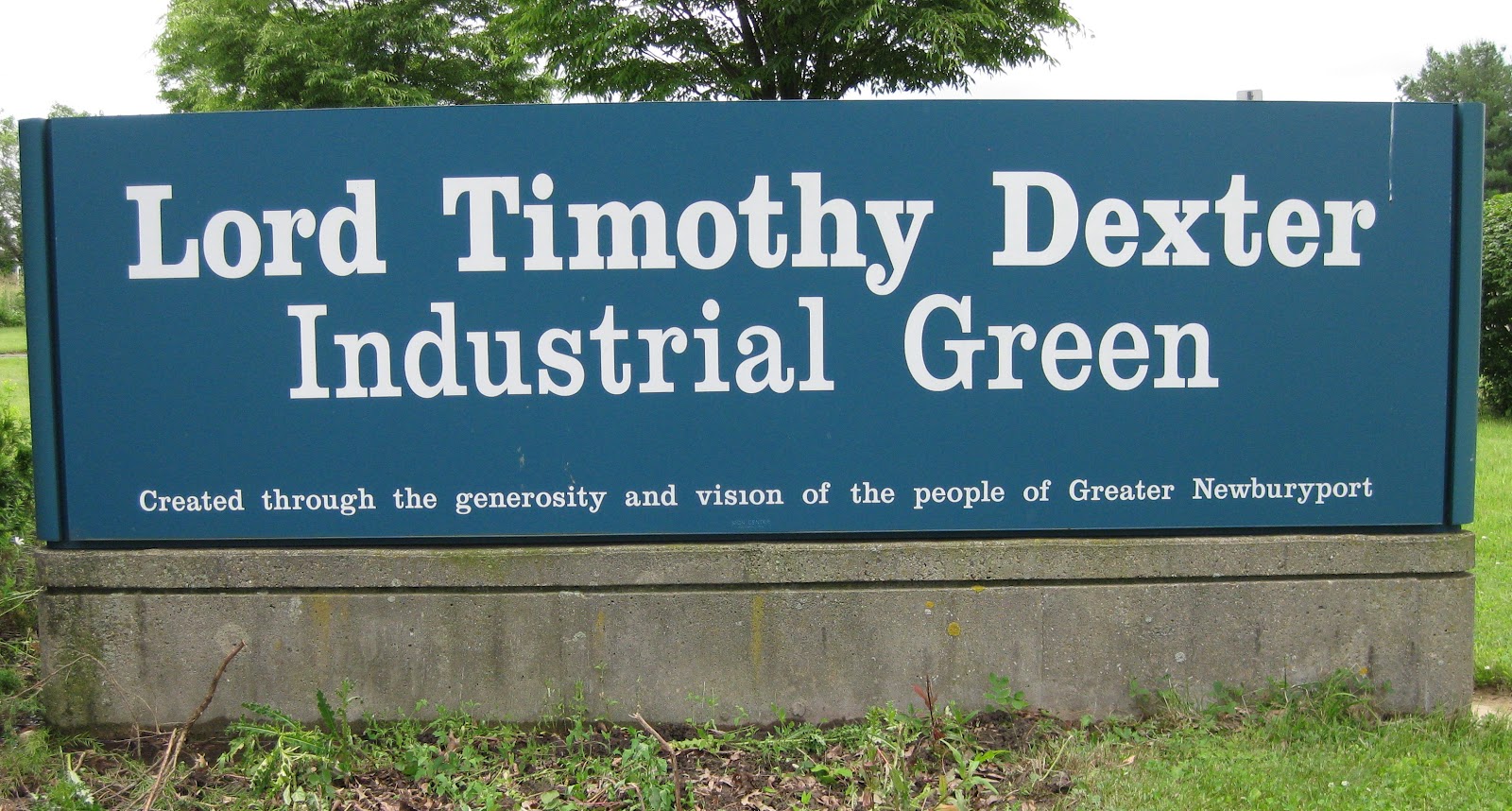
As a footnote to all this, a couple of years ago I was driving through Newburyport, Massachusetts, where Lord Timothy lived and I saw a number of references to him including the name of the local industrial park where he'd once owned land. But doing a quick search of the internet just now I find that they're about to rename their industrial hub. They're going to give it the much less memorable name of Newburyport Business Park. We can only hope the new sign says something like: 


Newburyport Business Park ////,,,,,???...:::;;;;;!!!!!!
(and maybe @@@@ to bring it up to date)

Sunday, March 4, 2012

Clean Up Australia

Today was Clean Up Australia Day and many thousands of volunteers around the country gave up a couple of hours of their time to make it a better, cleaner country. This is an annual event that began in Sydney in 1989 and has now spread around the country.

Below is the Glebe, Sydney, NSW contingent who cleaned up Glebe's Sydney Harbour foreshore parks: Bicentennial Park, Federal Park, Jubilee Park, Pope Paul Reserve and Blackwattle Bay Park, which are really all one big park.

Clean Up Australia Team Glebe
The wonderful fire-fighters at the Glebe fire station joined Team Glebe while remaining on call. (As far as we know, no houses burned down while they helped out.)

Jeroen explaining the finer points of picking up rubbish
Jeroen, was this year's organiser. He also organises his own monthly clean-up of the public spaces around Glebe.

A cleaner Rozelle Bay
There is a program to regenerate the mangroves that once lined the Glebe foreshore. You can see it in its early stages to the right of the breakwater.

An thinly-veiled excuse to show myself doing something useful.
Flotsam is a problem. Litter from the land areas can be kept under control but every time the tide comes in the rubbish that's thrown off boats comes ashore.

Thirty two good reasons for container deposit legislation
If you're a drinks producer you won't want to hear this but container deposit legislation would greatly reduce rubbish. South Australia and the Northern Territory are the only places in Australia with bottle deposit laws. We need a national law but there is strong lobbying against it.

Two ecstatic members of Clean Up Australia Team Glebe showing off part of the haul.
It is amazing what an impact some volunteers can make. So put it in your diary for next year and join the fun.  You will feel suitably virtuous for ages afterwards---and guilty if you don't.


Plus you'll get a certificate like this. How good is that?

Friday, March 2, 2012

In the Footsteps of Charles Darwin

In 1836 Charles Darwin, then 27, and sailing around the world on HMS Beagle, docked in Sydney. From there he made a side trip to the Blue Mountains and over the ranges to Bathurst. On the way he and his guide stopped on what is now the Great Western Highway and walked along a track to look out over the Jamison Valley. As he wrote in his diary:
About a mile & a half from this place there is a view, exceedingly well worth visiting. Following down a little valley & its tiny rill of water, suddenly ... an immense gulf is seen at the depth of perhaps 1500 ft beneath one's feet. Walking a few yards farther, one stands on the brink of a great precipice. Below is the grand bay or gulf, for I know not what other name to give it, thickly covered with forest. The point of view is situated as it were at the head of the Bay, for the line of cliff diverges away on each side, showing headland, behind headland, as on a bold Sea coast. ... The class of view was to me quite novel & certainly magnificent.

The route Darwin took is now named the Charles Darwin Walk and it leads to the top of Wentworth Falls, which even at the time of Darwin's visit, was already a popular tourist attraction. Back then you could only stand and look out over the Jamison Valley but now, thanks to the staff of the Blue Mountains National Park, and all the work they've done constructing walking paths, you can descend the "line of cliff" and walk along it. One thing hasn't changed from Darwin's time: the view over the Jamison Valley is still pristine.


Last week my old friend and fellow author, Richard Tulloch, and I did one of our favourite walks at Wentworth Falls, The National Pass. Starting at the Conservation Hut Cafe at the other end of the escarpment from where Darwin was and, after fortifying ourselves with coffee and scones (with jam & cream) we started off down the track. Ignoring  the Yowie warning sign.


The Conservation Hut Cafe

Yowies are  Australia's answer to the Yeti and Bigfoot. Sadly, we didn't see one. It would have made for an interesting blog entry. Unfortunately Darwin didn't see one either as it would have given his book The Descent of Man that little magic something to keep it in the charts a bit longer.

Beware of the yowie
In any event these men descended to Lodore Falls, Sylvia Falls and Empress Falls on the Valley of the Waters Creek. A group of canyoners were busy canyoning down the creek. We stopped to watch just long enough to be happy to be warm, dry and on foot.

The National Pass Track

The National Pass track traverses the middle of the cliff from the western (Conservation Hut) end to the eastern, Wentworth Falls end. Or the other way around depending on where you've parked. I've drawn a red line on the photo above to show were it goes. If this looks scary, it's really not. The track is well-maintained and the National Park people have made every effort to keep people from unnecessarily plummeting to their deaths. I guess it's in their interests, too.


A paved path---not to every bushwalker's taste

It was a warm day but, considering it's summer here, we were just pleased that we weren't walking in blistering heat. But it is a well-shaded walk and it's been so rainy recently that there was always a bit of cooling spray from above.

Low overhead
A few stretches are better for kids---short ones---than adults.

Richard in welcome shade
Okay so now you wish you were bushwalking instead of staring at a computer screen. You can get to the Blue Mountains from Sydney by car, bus or train and there's all the information you need at the various Park information centres---such as the one in Springwood on the Great Western Highway on the way to Wentworth Falls. There are also excellent guide books. My favourite so far is Blue Mountains Best Bushwalks by Veechi Stuart. For those of you from away, Sydney is just a short plane ride. Just hop on the plane, go to sleep for a day or so and you're here.

The railing does take away some of the fun

A metal lizard climbing a new, very classy, National Pass trail marker

A real lizard, an Eastern Water Dragon, standing in our path


The track has wonderful views out over the valley but, equally interesting, is the variety of plant life on the cliff face. There are a number of plants that grow only the wet rock faces in the Blue Mountains and nowhere else in the world. If I knew anything about plants I'd have included a photo of one.

Wentworth Falls from below
At the other end of the track we arrived at Wentworth Falls. It's a good climb up but there are stretches of metal stairs that make it easy. This is part is a popular walk so it can be a bit of a conga line on weekends.

The upper part of Wentworth Falls
Once on top of the Falls the trip was only half over. From here we again traversed the cliff line on the Overcliff Track back to the Conservation Hut Cafe and rewarded ourselves for our efforts with a filling lunch. 


Back to Charles Darwin's brief trip to Oz: he wasn't as excited by the fauna here as he had been in the Galapagos because so much of it had already been described. He didn't see a yowie but on his trip to the Blue Mountains he came across other animals that puzzled him. He saw a rat-kangaroo that seemed to fulfil the same function a rabbit does in England. And he saw a platypus that was much like an English water vole. But both were very different in anatomy. In his diary he wondered who one creator would have designed different animals to fill similar ecological niches in different parts of the world. It wasn't an original thought but Darwin eventually pursued it in a way that on one else did. Using this and other evidence he collected on his voyage he wrote a book with the catchy title, On the Origin of Species by Means of Natural Selection, or the Preservation of Favoured Races in the Struggle for Life. We know it simply as On the Origin of Species


So there you have it: if it hadn't been for a tourist visiting the Blue Mountains years ago we would never have had the Theory of Evolution. QED.

Sunday, February 26, 2012

Museum of Fire


These days we're all bombarded with photographs from the internet many of which seem too good to be true. Many of them aren't true. But I can vouch for this one taken on the M4 in the Western Suburbs of Sydney last Friday. No, the Museum of Fire---actually a museum of fire fighting---wasn't burning down but a warehouse nearby was. Fortunately, there were no deaths or injuries.

My good friend and fellow author, Richard Tulloch, and I were driving back to Sydney from a bushwalk in the Blue Mountains when we saw smoke from the fire and then the seemingly-appropriate sign. Sadly our serious cameras were in the boot of the car and there was nowhere to pull over to get to them but I managed to get out my pocket camera (I was driving) and handed it to Richard who snapped this photo. The moral is: always have a camera with you,  especially if you're feeding a hungry blog.

Sunday, February 19, 2012

Accidental Animals

I could never be a nature photographer. I'm just not patient enough to wait in a hide at night for a mother Eurasian Eagle Owl to return to the nest with a freshly-killed mouse, or to crawl around a malarial swamp photographing the mating habits of a False Gharial, or to spend my life searching for last living Night Parrot or Tasmanian Tiger. But I do walk a bit both here in Australia or wherever I might be and I often have Canny the 3rd, my trusty pocket camera, with me. While I could never work for David Attenborough I've had my share of the gadget-bag essential---good luck.


I was with some birdwatcher friends in their backyard in Massachusetts and, while their binoculars were trained on their bird-feeder, I looked down on the ground and saw this baby Striped Skunk. It let me get very close before raising its tail and running away. Fortunately it was too young to spray me. It was incredibly cute, as I hope you'll agree, but not old enough to make scents.


These Rainbow Lorikeets were in a park near where I live in Sydney. They let me get very close before flying away. They are very common but so strikingly colourful that I can never resist photographing them when they give me a chance.


This New Zealand Fur Seal was warming up on the rocks at Kaikoura on the South Island of New Zealand. Its mother, behind me, wasn't as happy about my informal photo-shoot. She made a quick movement towards my legs and I legged it very quickly out of bite-range.


While I was walking on a country road in Maine some young relatives of mine called me over to their backyard. They showed me these baby North American Raccoons in a hollowed out apple tree. Once again, I had a camera in hand---rather, in pocket.


Royal Spoonbills are not uncommon here in eastern Australia. This one was in a park near me rummaging through the water plants in a pond and allowed me to get close to it before it flew over to the other side of the pond. It was clearly annoyed that I'd interrupted its dinner.


I can't claim this photo as my own. Near Boothbay Harbor, Maine, this whale suddenly surfaced. I was at the helm of the boat and quickly cut the engine. I couldn't get to my camera in time but my cousin, Johnny, obligingly took this photo. We thought it was a Minke Whale but this is all we saw of it. It dived and we didn't see it again.


On another boat, this time on a trip up the Ord River near Kununurra, in northmost Western Australia, this lizard was sunning itself. I don't know what kind it was but it was big, fast and loved the water. If you know what it is, please leave a comment.


I was walking around Iron Cove on Sydney Harbour when I spotted this Australian Spotted Jellyfish. They're common here but I'd never seen one before. Jellyfish don't race away when you try to photograph them which is fortunate as it took a while to get a photo that didn't show the clouds above better than the jellyfish itself.


Closer to home, this sausage-size caterpillar (species unknown) appeared in our tiny back garden. I watched it for a while carving great chunks out of some of our favourite plants. I'd have loved to see whether it eventually turned into a butterfly or a moth but by then we wouldn't have any garden left. So I took it for a walk to the park where it would have more to eat. I can't identify it so if anyone can, please leave a comment.


Huntsman Spiders make guest appearances in our houses here in Sydney. They don't actually come in to the house but just magically appear inside on a wall or ceiling. Their bite isn't deadly but they can bite and they are memorable to look at. This one is the span of a child's hand. Okay, a smallish child's hand. They have two speeds: deathly still and frighteningly fast. 

I'm the designated spider-catcher-in-chief because I'm not quite as terrified of huge spiders as my wife is. I use the bowl and magazine method and then release them in the park across the street closer to the neighbours' houses. Huntsmen (Huntsmans?) aren't always easy to catch. Just when I'm about to clap the bowl over them they often shoot off. Perhaps the screams of, "Catch it, Duncan! Catch it! Get it out of here! Oh, yuck! Horrible. Horrible." disturbs them.

If you enjoy this blog, why not subscribe? Just put your email address where it says FOLLOW BY EMAIL at the top right of this page and you'll be sent an email to confirm that you want it. You can always unsubscribe if it gets boring..

Monday, February 13, 2012

Treaty of Tordesillas

Why do they speak Spanish in most of the countries of South America except Brazil where they speak Portuguese? I found the answer quite by accident in Tordesillas in Spain. We were driving from Galicia in northwestern Spain to Madrid in the centre. It was getting late when we arrived in this town so we decided to spend the night. At our hotel they told us that it was the day of the annual celebration the Treaty of Tordesillas. We hurried to the main square and watched a re-enactment of the signing of this famous treaty in 1494. 


In the late Sixteenth Century, Spanish and Portuguese explorers were sailing around the world searching for a water route to India and claiming the lands that they found in the process. Christopher Columbus had just snapped up various islands in the Caribbean and the Portuguese and the Spaniards were madly mapping the coastline of the New World.


Instead of fighting over these newly-discovered lands, King John II of Portugal and the king and queen of this part of Spain---Castile and Aragon---made a deal. They would draw a line on a map from north to south through South America. Portugal would get everything east of it that hadn't already been claimed and Spain would get everything to the west of it. This gave what is now the coast of Brazil to Portugal and almost everything else to Spain. Not a great deal for Portugal and maybe this was because the pope, who had been born in Spain, was in on the negotiations.


We got to the middle of town just ahead of the troops of the Ferdinand and Isabella, the Spanish king and queen.


Then along came the striped soldiers of the representatives of Pope Alexander VI.


Followed by the the troops of King John II of Portugal.


They assembled in the main square, the Plaza Mayor, while the present mayor (with her back to us in the picture below) read out the proclamation of the Treaty. We listened respectfully, not understanding much of the mediaeval Spanish.


Towns and cities around the world have their celebrations but this one was especially fun for us because we'd happened on it by accident, because it was such a friendly atmosphere and because we seemed to be the only out-of-towners. It's rare to be the only tourists at an event like this. And we actually learned something.

The one thing missing were South Americans. This was probably not surprising since this was a celebration of the carve-up of their continent by a bunch of greedy foreigners.